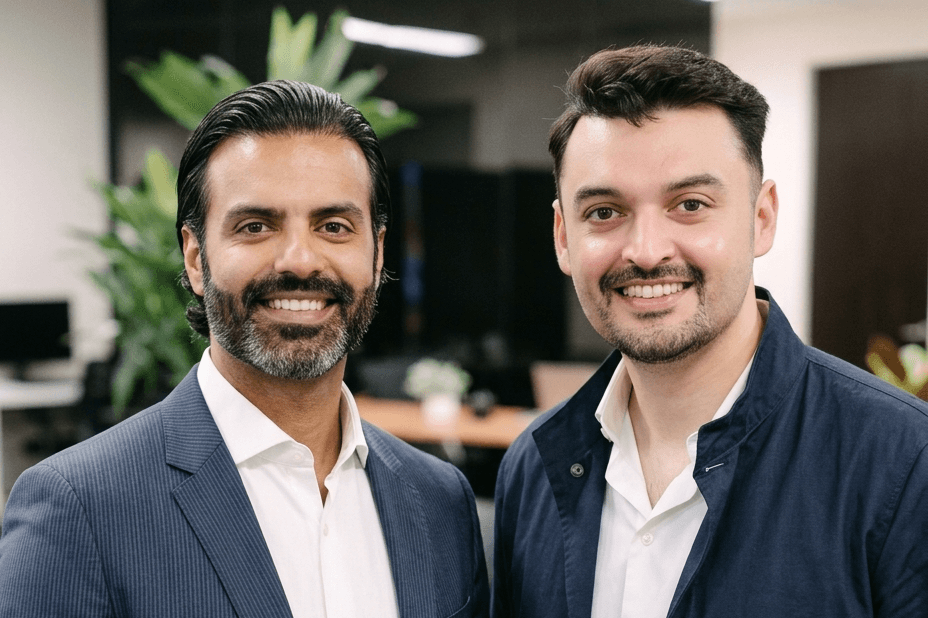
A joint statement from Sheharyar Ahmad (CEO) and Zayad Malik (CTO) on why we are building Sukrat AI — proactive intelligent tutoring for every student.
"Knowledge emerges only through invention and re-invention, through the restless, impatient, continuing, hopeful inquiry human beings pursue in the world, with the world, and with each other."
— Paulo Freire, Pedagogy of the Oppressed (1968)
Why We Are Building Sukrat
Ever since we met in undergrad in 2006, we've been trying to find out ways to change the world around us for the better. One of us topped the civil service exam and ran public sector programs at sovereign scale, the kind where a single decision impacts the lives of hundreds of thousands of individuals. The other went to Silicon Valley and spent years selling and building technology into some of the largest education institutions in the world. We were both, in our own way, striving to make a difference, but more than often learning how systems so often fail the people inside them.
In March 2026 we reconnected at a café in our hometowns. The world as we had known it was changing at a pace unseen before in human history. AI, with both the potential and peril it holds, could be a way to reshape how our coming generations learn and grow. Within minutes we realized we had independently reached the same conclusion: schooling as we had known it for more than a hundred years would be gone in the next 3-4 years.
We could see the future plainly: artificial intelligence now lets you compress and generate vast amounts of information, and with it, knowledge. Students and teachers are already using unrestrained AI products, both playing a game of cat-and-mouse, with no resolution in sight.
On the flipside, what used to take ten years of conventional schooling could now be taught in a fraction of that, because a model can generate infinite, personalized explanations and practice at almost no cost. Given this is true, then turning a student into a genuine polymath should no longer depend on where they were born, what curriculum they study, or whether they happened to have a good teacher.
Those three barriers (access, learning environment, and the variation of teacher quality) had defined who got access to quality education. For the first time, none of the old assumptions held.
That was the moment that Sukrat came into existence - inspired by Socrates, the master of masters - the best tutor a student could have, would now be available to all of them.
The Thing Everyone Gets Wrong
For the longest time, technology companies promised to make everyone learn faster and get better grades, by giving them a shiny new tool. A study planner. A note taker. Better exam prep tools. It is tempting to say that problems in education can be fixed by either providing quality study materials or an efficiency tool. It is not.
Walk into any school and you will find students with access to tutors, exam papers, study guides, virtual libraries, YouTube channels, and WhatsApp support groups. They are drowning in resources, yet so many still fall behind.
If the only thing standing between students and mastery was study material, then the invention of the printing press nearly 600 years ago and handing them books and letting them figure it out on their own would have solved everything. It has not, because education is a collaborative process. Turns out it does take a village to raise, and educate, a child.
The real problem is prioritizing what needs to be learned and teaching it in the way that the child is most receptive to. Classrooms can't provide that, because it's not humanly possible for a teacher to teach to each individual student in the limited time they have.
So the students learn what they can, not what they need. Effort gets spread evenly across everything instead of concentrating on the important concepts or fixing critical misconceptions. A student can move in the wrong direction and lose weeks before a failed quiz or exam makes them realize they didn't learn the correct way.
This is also why the first wave of AI in education disappointed everyone, including us. What was marketed as intelligence turned out to be a chatbot, that waits for you to ask the right question first. But a student who already knew the right question to ask would not need the help in the first place. Reactive tools reproduce the exact failure they claim to solve. The published engagement numbers from the best-funded attempts confirm it. Waiting to be asked is not tutoring.
What We Actually Built
We built an actual Intelligent Tutor, and we built it to be proactive by design. It is not a chatbot with a syllabus attached, but an entire system that adapts and grows with the learners' needs.
Underneath the hood are two separated layers. The first is an intelligence layer we built ourselves: a model of what each student actually knows, a prioritization engine that decides which gap matters most for their particular learning, and a map of how the curriculum connects. This layer makes the teaching decisions. The second is a content layer that uses frontier language models to generate calibrated learning outcomes, topics and concepts, and practice questions, so that what a student practices is faithful to what they will actually be assessed on in class, and in their exams.
The loop is simple to describe and hard to build: diagnose what you do not know, prioritize what matters most, give you practice at the right level, then adapt after every session. No two students get the same path, and the path keeps rebuilding itself.
For teachers, the same engine produces something they have never reliably had: a real-time, honest view of where every student stands, by topic and by exam risk. Not how many minutes they spent in an app but where the actual learning gaps are, individually and across the class. That is the difference between teaching to the middle of a class and intervening exactly where it counts.
For parents, the platform provides real time insights on how far and how quickly their children are progressing, what their strengths are, on a daily basis. No more waiting for weeks or months to read the exam scorecards and sitting through Parent-Teacher meetings to understand where your child stands.
The World We Are Building Toward
We are building the best tutor in the world, and we intend to give it to every student. Not one that is good enough for the many or excellent for the few. The best one, for all of them.
The rules for how education is given to students are being completely rewritten. We believe that the entire education system as it stands will be replaced in the next 3-4 years. What would replace it? Unlike what most EdTech companies claim and try to profit from, schools and teachers will not disappear: education is, after all, a collective endeavor that requires teachers, parents, and students to work toward a goal together. But the roles and functions of schools will be drastically different.
In a world where the entirety of human knowledge is available to everyone everywhere, the "heavy lifting" of teaching (repeating concepts, quizzing, and grading) will give way to focus on creativity, social skills, independent thinking from an early age.
We envision a world where a student's potential is no longer rationed by accident. Where the quality of your education does not collapse the moment you are outside the handful of geographies. Where a teacher walks into class already knowing exactly who needs what without having to put themselves through unsustainable working hours. Where becoming deeply and broadly capable (the old definition of a polymath) is an ordinary outcome of growing up rather than a rare stroke of luck.
Launching in our country also lets us prove something larger: that a system like this can change the destiny of a society, not just its exam scores. Decades ago, Cuba and later Nicaragua showed that a country can compress generations of educational progress into a few short years when every learner is taught directly, at their own level.
What those campaigns needed hundreds of thousands of volunteer teachers to do, an intelligent tutor can now do for every student at once. We are building for the government system as much as the private one, because get this right in Pakistan and you do not change one cohort. You change the trajectory of 250 million people, and prove a model the rest of the world can follow.
We are not claiming that AI will fix education on its own. Generic AI will not. A specific system that is built to diagnose, sequence, and adapt, will. We intend to prove it school by school, student by student. We have spent twenty years working within the systems that end up failing people. We are building the one that does not.
"To exist, humanly, is to name the world, to change it."
— Paulo Freire
Sheharyar Ahmad and Zayad Malik Co-founders, Sukrat AI